Systems that deliver

A production method I built to run AI work in small, reviewed steps, so the output is something I can stand behind.

This is a look at how I use context engineering in stages to produce content with AI tools. It is not software. It is a way of breaking a project into small stages, reviewing each one, while keeping every instruction in a plain file anyone can read. Below is a short video and the infographic that explain how it works.

Watch this breakdown of how context engineering with stages turns a big job into steps I can check as I go.

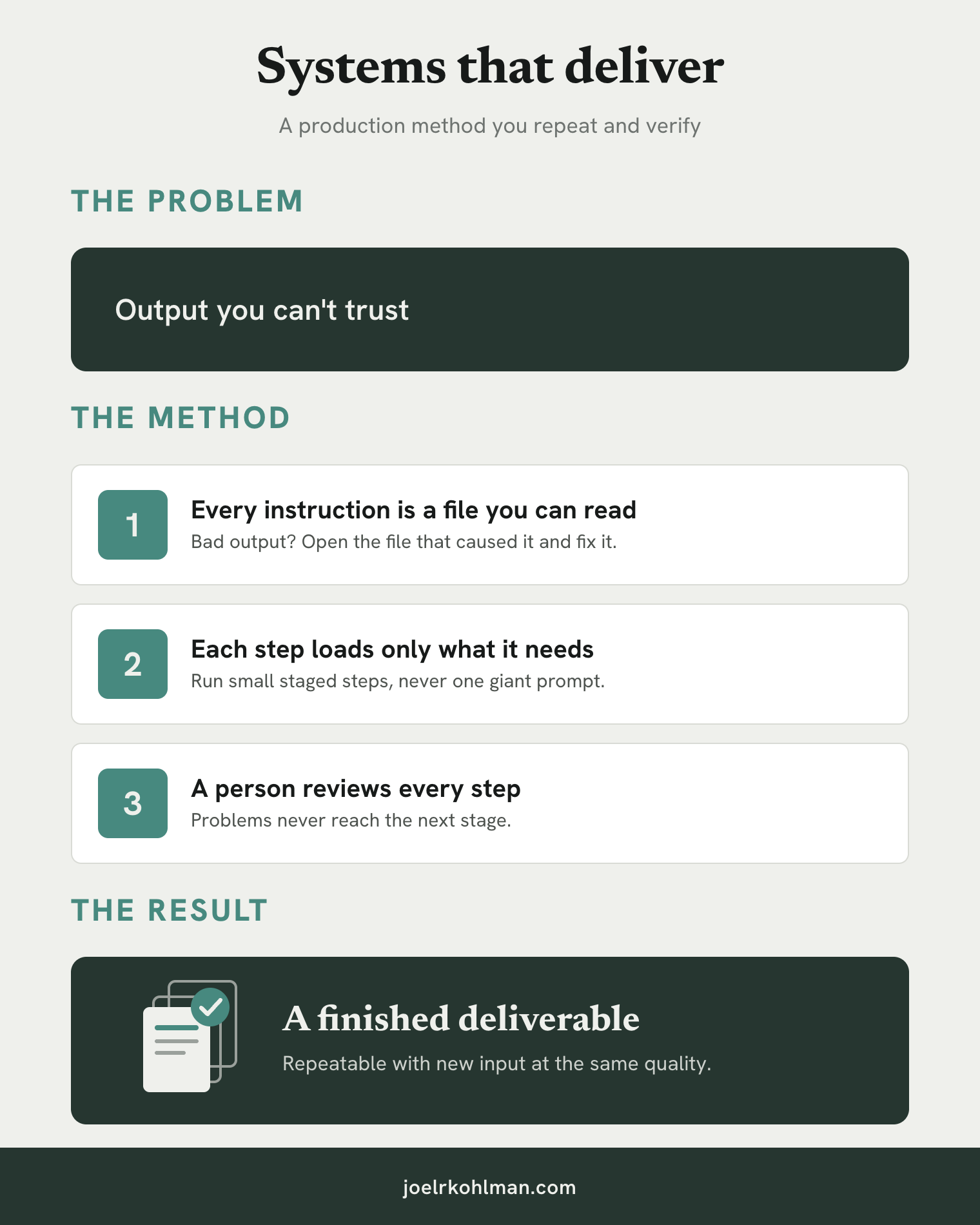
The full method in one image: the problem it solves, how it runs, and what comes out the other end.

What this is

This is a folder-based way to run AI work: markdown files and numbered stage folders instead of orchestration software. There is nothing to install and no runtime running in the background. Each step only loads the file it needs, so I point an AI assistant at the right file for that step, run one stage at a time, and review the output before the next stage starts. Every output is a file I can open and edit myself.

I did not invent this from nothing. The staged approach I use is my own adaptation of a method originally designed by Jake Van Clief, built and run across real instructional design, content, and knowledge-base work.

To be direct about the trade-off: this method gives up some automation and persistence in exchange for transparency and control. I can see exactly what ran, why, and what it produced, at every step. That is the point of it.

Why I built it

Most of my work runs through AI tools now. The research, and the development work behind my system, building knowledge bases out of large sets of content, and instructional design,  When I found Jake Van Clief’s method, I saw the potential right away. I put my own version together quickly. 

Building in stages has made me much more productive, and now I can trace every step of my work and reproduce it as needed. This page is one example of the method working.

The infographic and the video you’re looking at were both built with it.